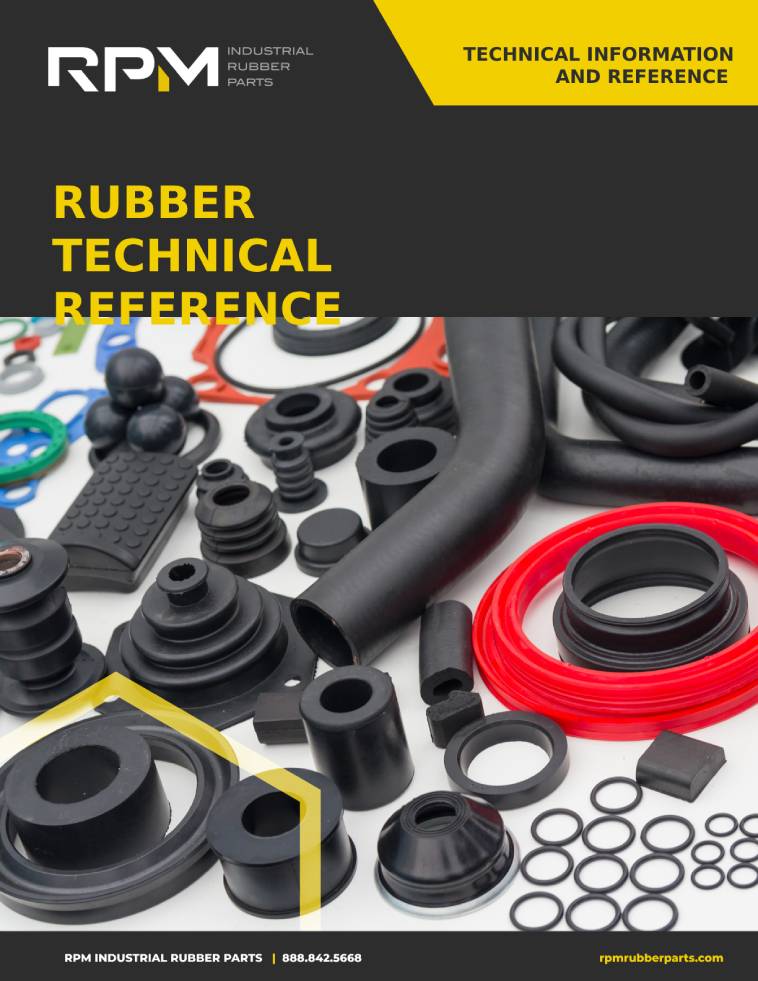
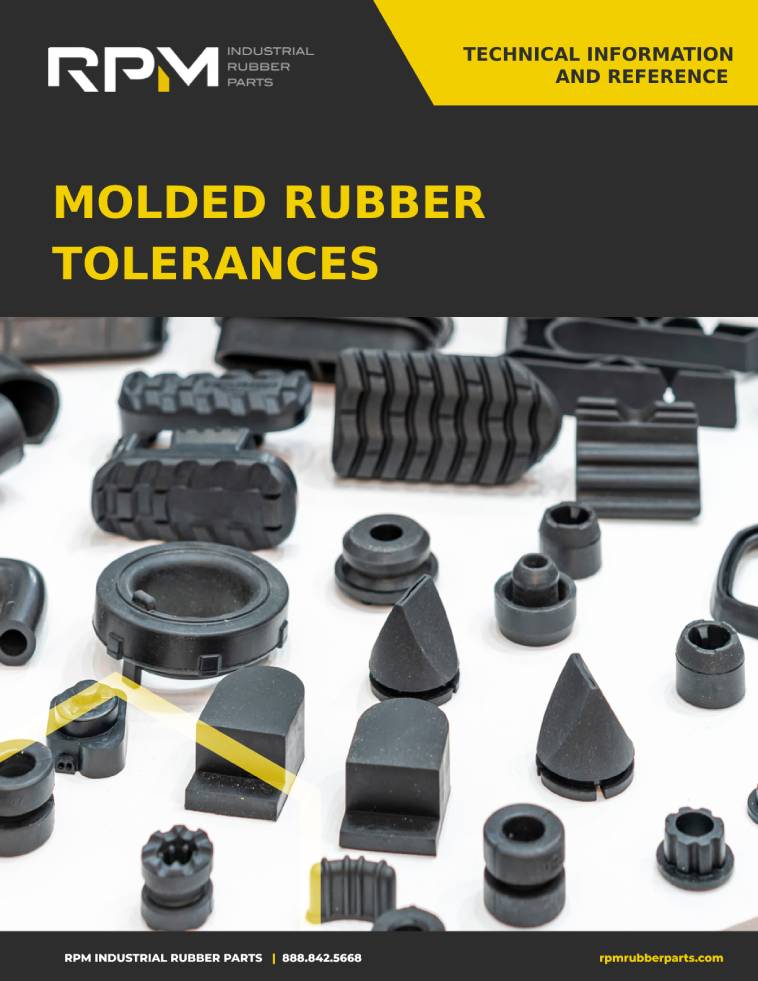
Every motor, pump, compressor, engine, and HVAC unit in a plant does the same thing while it runs its intended job: it shakes. That shaking — vibration — is energy that has nowhere to go, so it travels. It moves into the frame the equipment is bolted to, through the floor, into neighboring machines, and out as noise. Left unmanaged, it loosens fasteners, cracks welds, fatigues structures, blurs the readings on precision instruments, and quietly shortens the life of the very equipment producing it.
Vibration isolation is the discipline of interrupting that path. Done well, it is one of the least expensive and most overlooked ways to extend equipment life, cut noise, protect product quality, and keep a warranty intact. This guide is the starting point: what isolation actually is, why it matters, and how the rubber mounts, isolators, and bushings that do the work are put together. It is the first in a series that will go deeper on durometer, natural frequency, material selection, and mount design in the months ahead.
What Vibration Isolation Actually Means
Vibration isolation is the use of a flexible, resilient element placed between a vibrating machine and its support structure so that far less of the machine’s motion is passed along. Instead of a rigid, direct connection that transmits nearly every shake straight into the floor, you insert something that can flex, absorb, and give back energy in a controlled way. In most industrial equipment, that resilient element is engineered rubber — a rubber-to-metal mount, an isolator, or a bushing.
There are two directions the problem can run, and good isolation handles both. In source isolation, the machine is the troublemaker and the goal is to keep its vibration from reaching everything around it — think of a reciprocating compressor you do not want rattling the whole building. In receiver isolation, the equipment is the victim, and the goal is to protect a sensitive machine — a measuring instrument, an electronics enclosure, an optical system — from vibration coming in through the floor. The physics is the same in both cases: put the right flexible element in the path and most of the energy never crosses it.utput over input. In any vibration isolation system, the goal is for the output to be as low as possible. That represents the most significant amount of isolation. On a chart, the peak may remain at the same magnitude. The goal is to be on the tail end of the curve, where we will attain the highest isolation level.
Do you really know everything about designing with rubber parts?
Get a free and valuable resource for finding or custom designing the exact part you need.
Why It Matters More Than Most Teams Realize
The cost of ignoring vibration is rarely a single dramatic failure. It shows up as a slow accumulation of problems that get blamed on other things. Fasteners back out and have to be re-torqued. Bearings and seals wear early. Welds and brackets develop fatigue cracks after thousands of hours of micro-flexing. Sensitive electronics throw intermittent faults. Product quality drifts on equipment that depends on a stable platform. And the noise — often the first thing anyone complains about — is simply vibration you can hear, radiating off panels and structures that are being driven like a speaker cone.
There is also a commercial angle that engineers and buyers both feel. Many equipment manufacturers specify isolation as a condition of warranty, because uncontrolled vibration is a known killer of rotating machinery. Getting isolation right is not a nicety; it is frequently part of the spec. The payoff is longer service intervals, quieter facilities, more reliable output, and fewer surprise failures — all from a component that often costs a few dollars.
The Physics, Made Simple
You do not need to run the equations to make good decisions, but a few core ideas explain everything else in this series.
Natural frequency is the heart of it. Any machine sitting on a flexible mount has a natural frequency — the rate at which the machine-on-mount system likes to bounce if you nudge it. Isolation works by making sure this natural frequency sits well below the frequency of the vibration you are trying to block. A softer, more flexible mount lowers the natural frequency; a stiffer mount raises it. This is why you cannot just grab any rubber pad and expect results — the mount has to be tuned to the machine’s weight and its operating speed.
Isolation only begins once you clear a threshold. Engineers describe the relationship between the disturbing frequency and the system’s natural frequency as a ratio. Below a ratio of about 1.4 (mathematically, the square root of 2), a mount actually amplifies vibration rather than reducing it — a common and expensive mistake. Real isolation starts only once the disturbing frequency is comfortably above the system’s natural frequency, and it keeps improving the further apart the two are. As a practical rule of thumb, designers aim for the operating frequency to be at least two to three times the natural frequency.
Damping controls the worst-case moment. Every isolated system has to pass through its natural frequency briefly at startup and shutdown, and right at that point vibration spikes — this is resonance. Damping is the property that keeps that spike from getting out of hand and bleeds off energy so the system settles quickly. Rubber is popular precisely because it isolates and damps in a single, inexpensive material, where a bare steel spring would isolate but ring like a bell.
Those three ideas — natural frequency, the isolation threshold, and damping — are the backbone of every topic that follows in this series.
The Building Blocks: Mounts, Isolators, Bushings & Bonded Assemblies
Vibration control is delivered through a small family of components, each suited to a different job. Understanding what each one does is the first step toward speccing the right part.
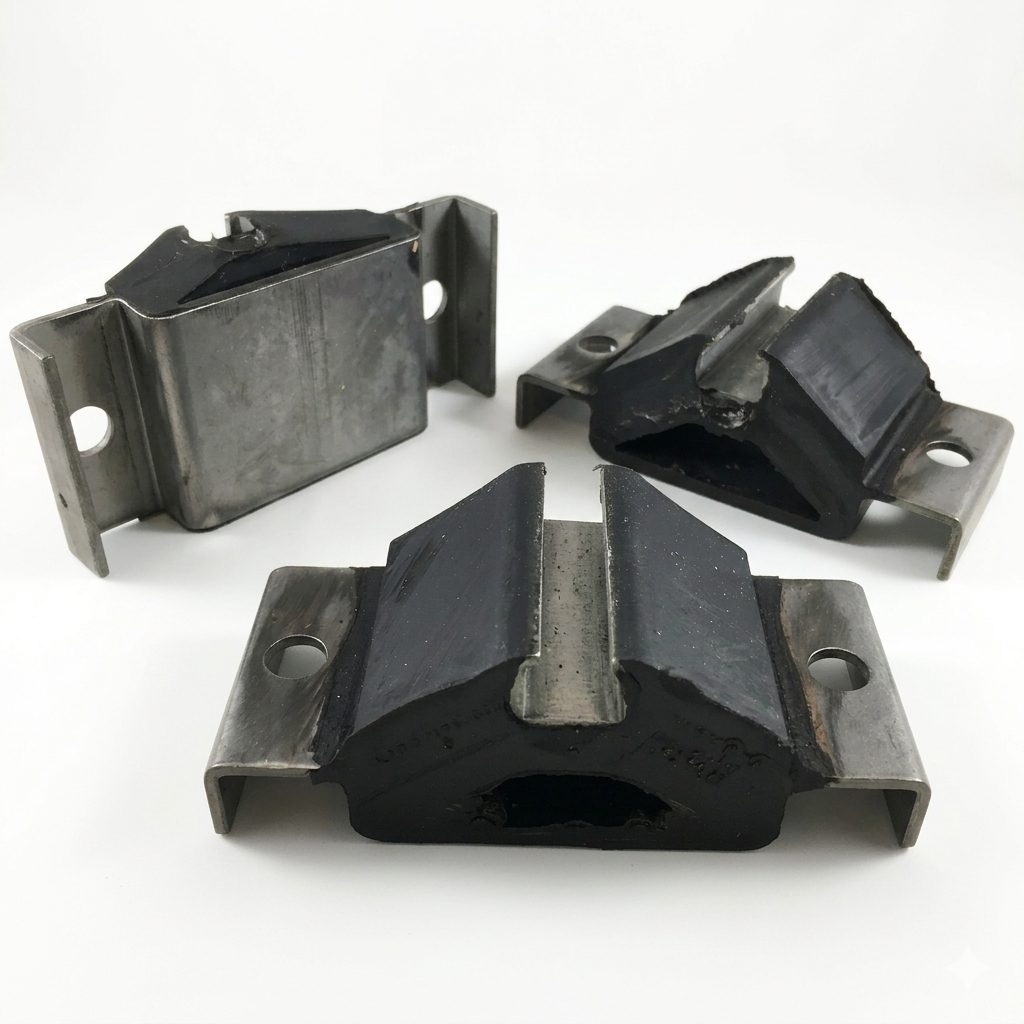
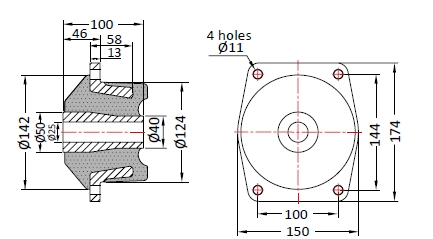
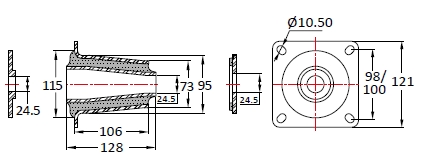
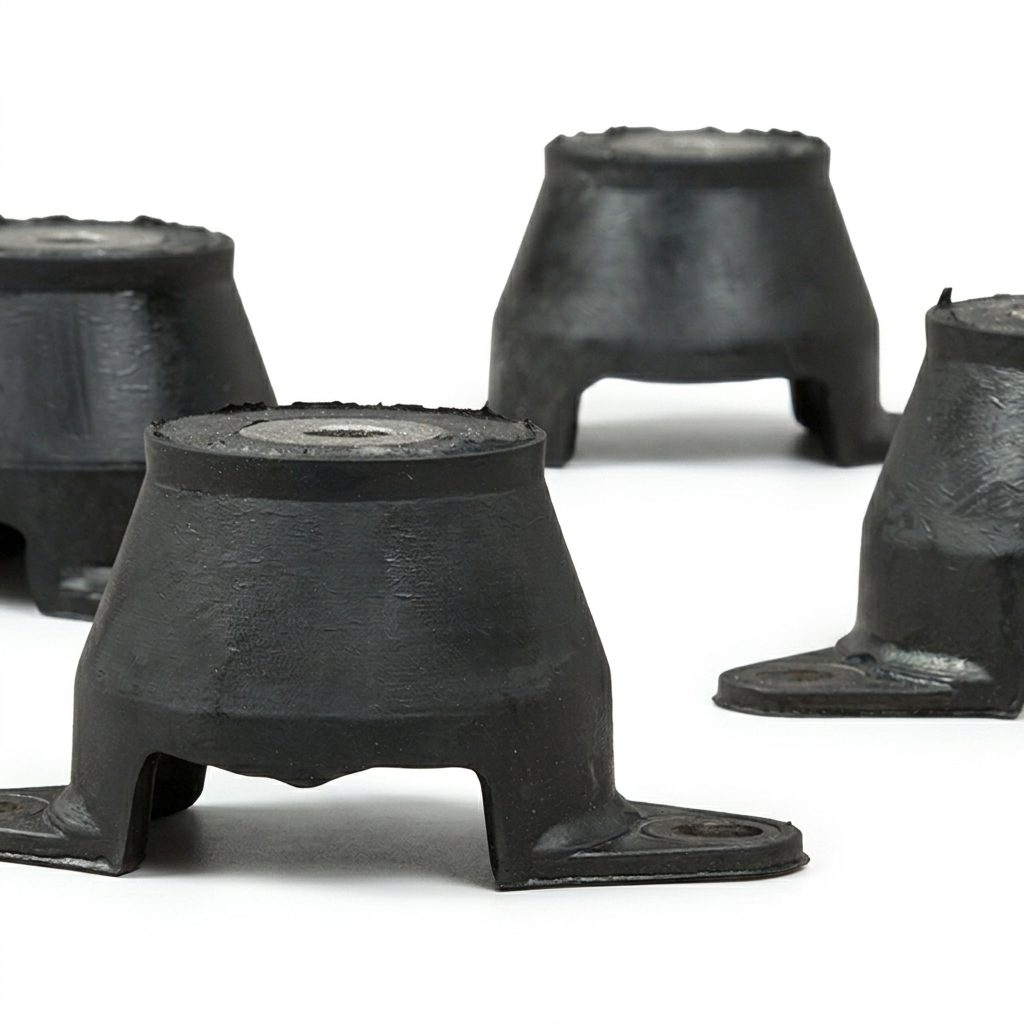
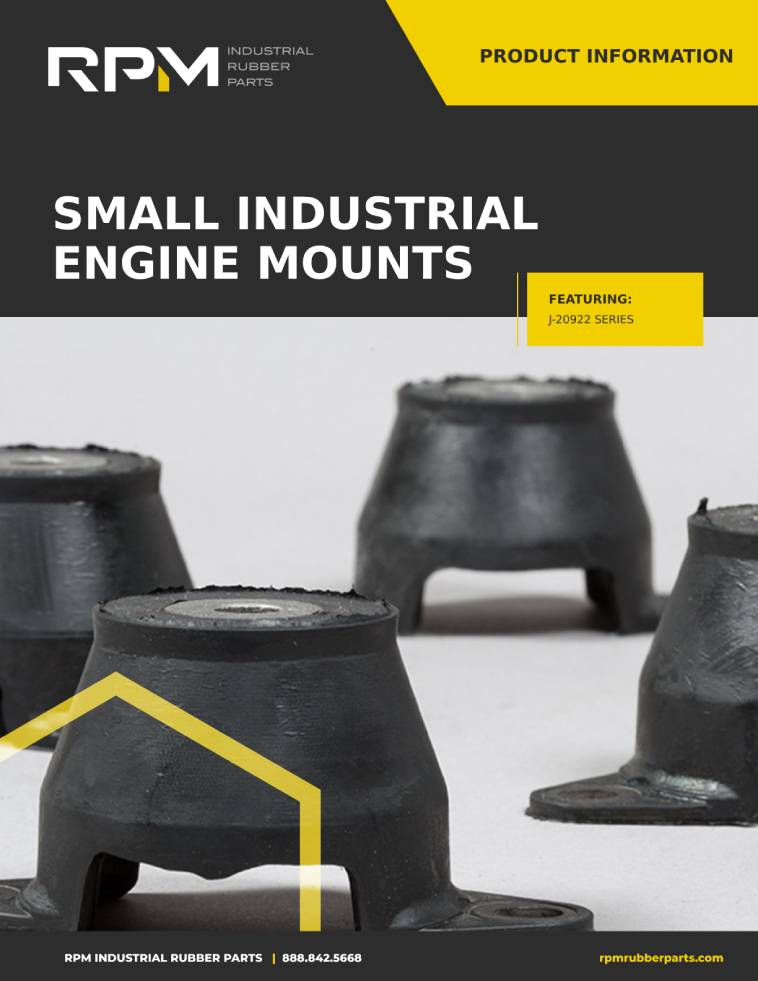
Anti-vibration mounts are the workhorses — a shaped rubber element bonded to metal fixings that bolt between a machine and its base. They carry the weight of the equipment while flexing to absorb vibration, and they come in cylindrical, conical, bushing, and bobbin-style forms to handle loads coming from different directions.
Isolators is the broader term for any component whose primary purpose is to break the vibration path. In practice the word often refers to mounts selected specifically for their isolation performance, but it also covers pads, grommets, and specialty designs used where a full bolted mount is not practical.
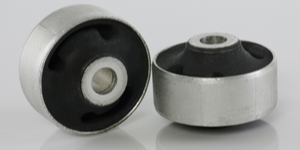
Bushings are cylindrical rubber elements, usually bonded between an inner and outer metal sleeve, that isolate vibration and absorb shock in a rotating or pivoting joint — think suspension links, linkages, and pivot points. They manage motion and vibration at the same time.
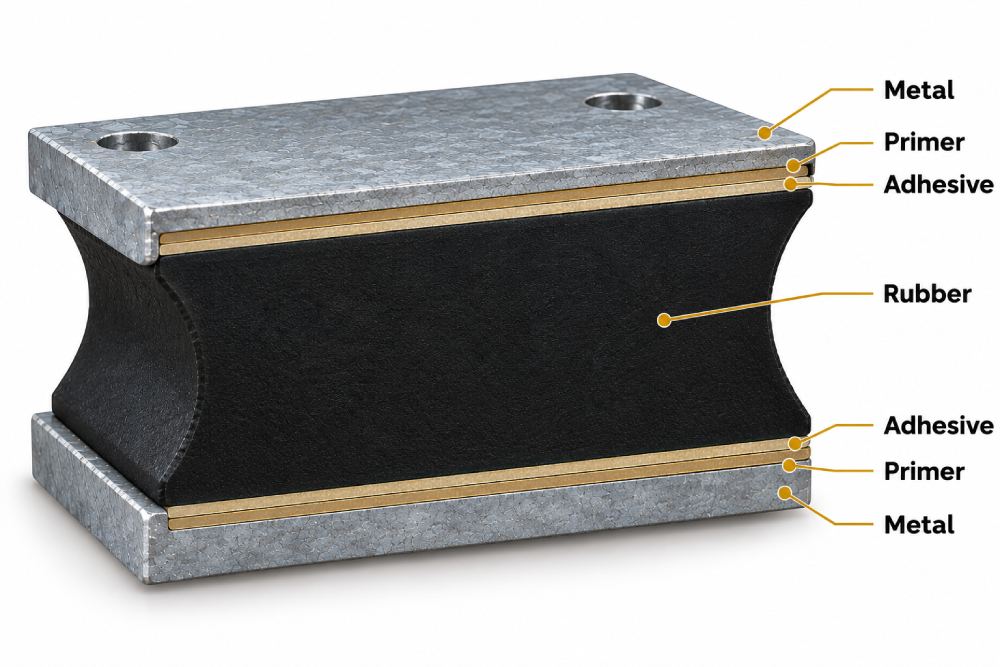
Bonded rubber-to-metal assemblies are the foundation under most of the above. Bonding chemically fuses the rubber to metal brackets, plates, or sleeves during molding, so the assembly can carry real structural load without the rubber tearing away from the metal — the stability of metal with the flexibility of rubber, in one part. This bond is what lets a small rubber part do a big mechanical job, and it is where manufacturing quality separates a part that lasts from one that fails early.
How Isolators are Actually Made to Work
The performance of any of these components comes down to the rubber compound and how it is engineered. The stiffness of the rubber — commonly described by its durometer, or hardness — sets how much the mount deflects under load, which in turn sets that all-important natural frequency. Softer compounds isolate low-frequency vibration better but carry less load; harder compounds carry more load but isolate less. Choosing the right hardness for the weight and frequency involved is a core part of getting isolation right, and it is the subject of the next article in this series.
Material choice matters just as much as hardness. Natural rubber offers excellent damping and fatigue life; neoprene brings better resistance to oil, weather, and ozone; silicone holds up across extreme temperatures. The operating environment — heat, chemicals, sunlight, load cycles — often decides the compound before performance does. We will cover material selection in depth later in the series.
A First Look at Selecting the Right Isolator
Full selection is a topic in its own right, but three questions get you most of the way to the right conversation. First, how much does the equipment weigh, and how is that weight distributed across the mounting points? The load on each mount drives the choice. Second, what frequency does the equipment run at — most often tied to motor or shaft speed — since that is the vibration you are trying to isolate. Third, what environment will the mount live in, because temperature, oil, chemicals, and outdoor exposure narrow the material options quickly. With those three answers, an application specialist can point you to a mount that puts the natural frequency where it belongs and survives the conditions it will face.
Common Mistakes Worth Avoiding
The most frequent error is choosing a mount that is too stiff, which pushes the natural frequency up into the range of the machine’s operating frequency and amplifies vibration instead of cutting it. A close second is ignoring the environment and watching a perfectly sized mount degrade because oil or ozone attacked the wrong compound. Others include mixing mismatched mounts under a single machine, over-constraining the equipment so it cannot flex the way the isolator intends, and skipping inspection — rubber isolators do age, and a worn mount silently stops doing its job. Each of these has a straightforward fix, and most trace back to speccing the part before understanding the load, the frequency, and the environment.
Where To Go From Here
Vibration isolation rewards a little upfront thinking with years of quieter, longer-lasting, more reliable equipment. The fundamentals are simple: put the right resilient element in the vibration path, tune its natural frequency below the disturbing frequency, and match the compound to the job. Everything else is refinement — and that refinement is exactly what the rest of this series covers, from choosing durometer to designing a fully custom mount.
If you are working through a vibration problem right now — early bearing wear, nuisance noise, a warranty spec you need to meet, or a sensitive instrument that will not settle — the fastest path is to talk it through with someone who does this every day. With more than 50 years of rubber expertise, 17,000 active parts, and over 25 million parts shipped a year, RPM Industrial Rubber Parts can review your application and match you with the right mount, isolator, or bushing for the load, frequency, and environment you are dealing with. And when the answer is a custom part, RPM’s proven process — consultation and design, prototype and pre-production, production, and delivery — takes it from spec to shipped.
Related Resource
The Engineer’s 7-minute Guide to Rubber Molded Parts
Our free resource is a quick-reference guide to help you determine if exploring a rubber part is right for your application.