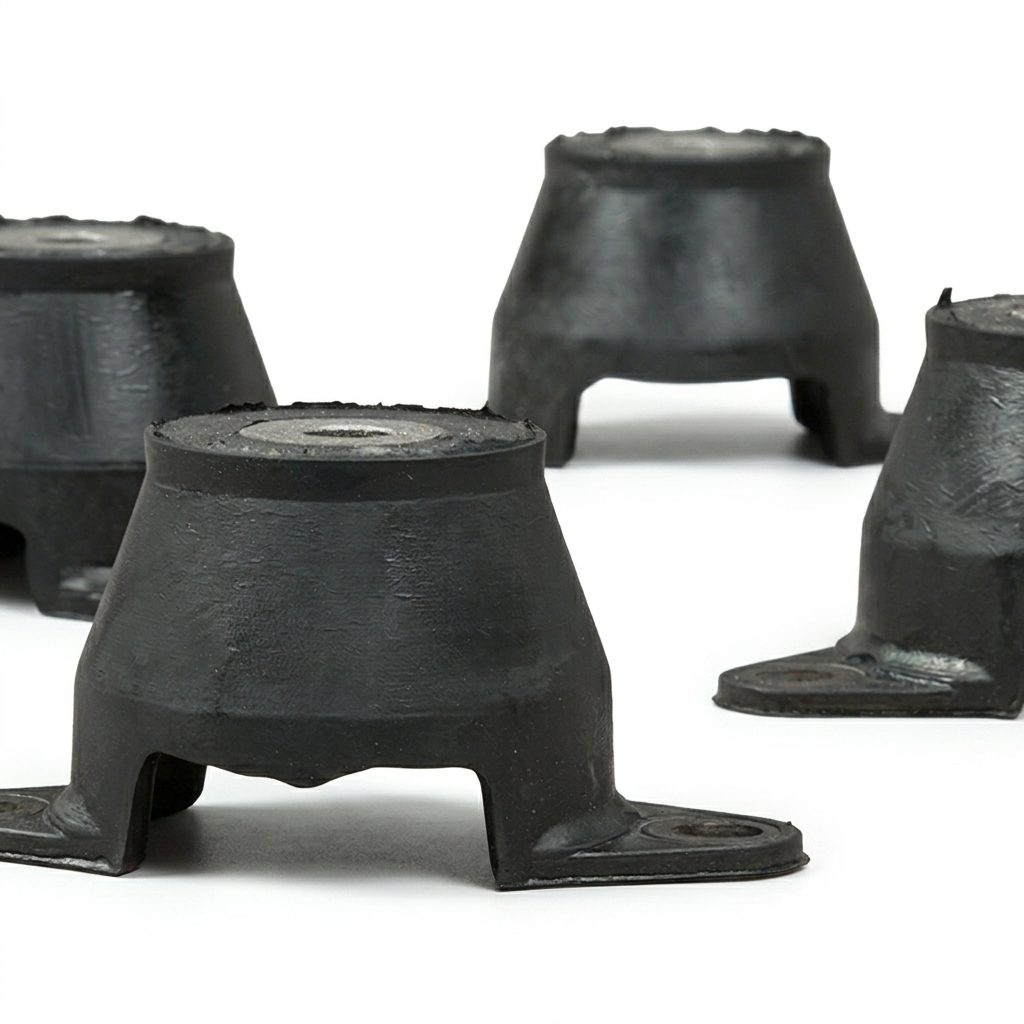
Three decisions sit behind every vibration mount. Durometer sets how well it isolates. The bond decides whether the assembly holds together. And the compound, the actual rubber the part is made from, decides how long it survives where you put it.
The first two usually get specified. The third often gets inherited, which is how two mounts with the same dimensions, the same hardness, and the same catalog page end up performing nothing alike after eighteen months in service. One is still doing its job. The other is cracked, swollen, or quietly carrying a different spring rate than the one it was selected for.
For almost every industrial mount, that choice comes down to two compounds: natural rubber and neoprene.
What Natural Rubber Does Better Than Other Rubber Compounds
Natural rubber is the benchmark every other mount compound is measured against, and it is what goes into most vibration mounts for a straightforward reason: nothing else matches it dynamically.
It is the most resilient of the common mount compounds, meaning it returns more of the energy you put into it instead of turning that energy into heat. That matters more than it sounds. A mount flexing thousands of times an hour is working against itself, and a compound with high internal friction generates heat inside the rubber, where it cannot easily escape. Internal heat ages rubber from the inside out. Natural rubber generates the least of it, which is a large part of why it lasts so long under continuous cycling.
It also leads on fatigue and tear resistance, takes high elongation without damage, and handles shock well. For a given durometer it deflects further than most alternatives, and as covered in “Vibration Isolation 101,” more deflection means a lower natural frequency and better isolation. Put simply, at the same hardness, natural rubber generally isolates more efficiently and survives more cycles.
There is a manufacturing advantage too. Natural rubber bonds readily to metal with well established adhesive systems, which is one reason so much of the bonded mount world is built around it.
Where Natural Rubber Reaches Its Limit
Its limits have nothing to do with performance. They are environmental, and there are three of them.
Oil and fuel. Natural rubber swells on prolonged contact with petroleum products, and a swollen mount no longer has the spring rate it was selected for. The distinction that matters is exposure, not presence. Occasional contact, splash, and the oil mist typical of an engine bay are well inside what natural rubber handles, and it is still the better performer there. Constant contact or immersion is where neoprene takes over.
Ozone and UV. Outdoor exposure cracks natural rubber, and the cracking starts where the rubber is under strain, which on a mount is exactly where it matters. It is worth knowing that ozone is not only an outdoor problem. Electric motors, welding operations, and high voltage equipment all generate ozone inside buildings, so an indoor mount can be sitting in an ozone source nobody has thought about.
Sustained heat. The practical ceiling for continuous service sits around 180°F. Above that, aging accelerates sharply.
None of this makes natural rubber a limited compound. Those three conditions describe the minority of installations, which is why natural rubber remains the default for most industrial mounting. The failures happen when a part gets specified for its dynamic performance and then installed well outside that window.
Where Neoprene Earns Its Place
Neoprene is the compound you choose when the environment is the harder problem to solve.
Its advantage is resistance. It takes constant oil and fuel contact, where natural rubber is limited to occasional exposure. It holds up to ozone, UV, and weathering far better, which makes it the default for anything mounted outdoors. It carries a higher service temperature, roughly 250°F. And it is inherently flame resistant, which occasionally decides the specification on its own.
The trade is real but modest. Neoprene is somewhat less resilient, so it generates more internal heat under heavy continuous cycling and tends to have a shorter fatigue life than natural rubber in the same duty. At the same durometer it isolates a little less efficiently. For most industrial equipment, that difference is comfortably inside the margin. For a machine cycling hard, continuously, in clean indoor conditions, it is the reason to specify natural rubber instead.
In one sentence: natural rubber is the performer, and neoprene is what you reach for when the environment will not let you use it.
What About the Other Compounds?
Those two compounds cover the overwhelming majority of industrial vibration mounting, and for most applications the honest answer is one of them.
Specialty elastomers do exist for narrow conditions, such as continuous immersion, aggressive chemical exposure, or temperatures well outside the normal industrial range. Those are engineering conversations rather than catalog selections, and RPM can specify one when an application genuinely calls for it. For everything else, the question in this post is the question that matters.
The Five Questions That Decide Rubber Compound
Compound selection is less complicated than it looks, because the same handful of answers resolves most of it.
- What does the mount come into contact with, and how often? Occasional splash and oil mist are a different problem from constant contact, and that difference is usually what decides between the two compounds.
- What is the actual temperature range? Not ambient. The surface temperature of the equipment the mount is bolted to, which is frequently much higher.
- Is it indoors or outdoors, and is there an ozone source nearby? Sunlight, weather, and the electric motors and welding equipment that produce ozone indoors.
- What is the duty cycle? Continuous high-frequency cycling pushes hard toward low-hysteresis natural rubber. Intermittent or light duty opens the field.
- Are there fire or flame requirements? If so, that may settle the question before the others are asked.
Answer those five and the compound usually names itself. Where two compounds both fit, the tiebreaker is whichever the environment treats more kindly, because dynamic performance is recoverable through sizing and an environmental mismatch is not.
Compound and Durometer Are One Decision, Not Two
A point worth being precise about, because it causes real selection errors: 60 Shore A natural rubber and 60 Shore A neoprene are not interchangeable parts. Durometer describes hardness. It says nothing about resilience, damping, fatigue life, or how the compound behaves when it is warm. Two mounts can measure the same on a durometer gauge and behave differently in every way that matters dynamically.
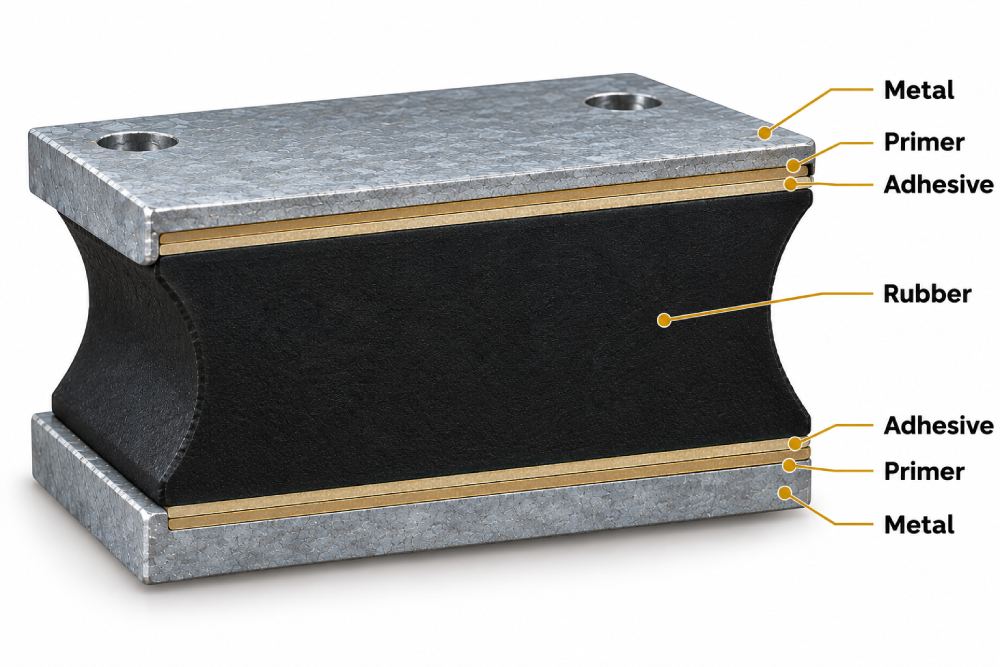
So the two specifications travel together. Choose the compound from the environment, then size the durometer from the load using the published load-deflection data for that compound, not a general curve. And as covered in last month’s post on bonded mounts, the compound has manufacturing consequences as well, because the adhesive system has to suit the elastomer being bonded.
The Rule of Thumb for Isolation Mounts
- Most industrial mounting, including occasional oil contact: natural rubber. It is the best dynamic performer and the right default unless something rules it out.
- Constant oil or fuel contact, washdown, sunlight, outdoor mounting, or elevated temperature: neoprene.
Everything else is refinement on those two lines.
Put the series together and the shape of a well specified mount is clear. Durometer decides how well it isolates. The bond decides whether the assembly stays an assembly. The compound decides how long any of it lasts. Three decisions, usually made as one, and almost always worth asking about separately.
RPM stocks mounts across the compound and durometer range, so the choice stays an engineering decision rather than a question of what happens to be on a shelf. The full vibration control line is a good place to start.
Next in the series: transmissibility, the single number that tells you whether a mount is isolating vibration or amplifying it.